
Bloom Virtual Village
Testing, game improvements, and browser access for an existing educational game.
- Client
- George Brown College
Direct engagement - Our contribution
- Testing, development,
and bug fixes - Starting point
- An existing game
Supporting learning through an interactive care setting.
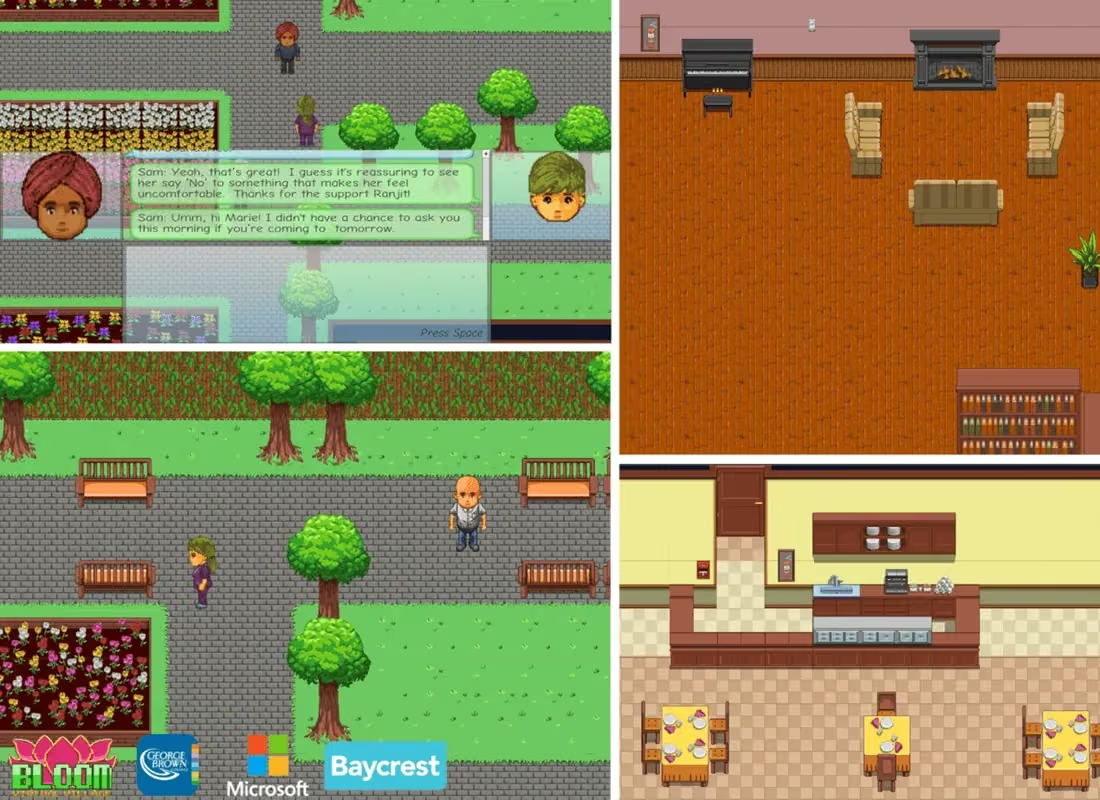
Bloom Virtual Village is an educational game for health sciences students. Players explore a long-term care facility and work through situations involving its residents.
The game had already been built when George Brown College commissioned INFRAR3D to make improvements, implement changes, and resolve bugs.
The need
The college needed changes across game setup, navigation, dialogue, and video playback. It also wanted a browser version and features for managing access, progress, and the pace of play.
The work called for understanding an existing game and making changes within it.
Our role
INFRAR3D took over testing and development. We tested the game, investigated issues, implemented the requested improvements, and corrected bugs.
The original design and development preceded our involvement. Our engagement followed that earlier phase and focused on improving and extending the existing game.
Original project background by Carl SpidlaThe approach
We used test findings and the college's requirements to guide the changes. The work addressed individual interactions as well as the rules connecting each day of play.
Alongside those corrections, we created a WebGL build for browser access and added features for returning players and classroom use.
Repairs and additions across the experience.
Game flow and bug fixes
Corrected issues with avatar setup, video playback, dialogue progression, and character movement. Updated day selection so players could revisit completed days without jumping ahead.
Browser access
Created a WebGL version of the game that could run in a web browser.
Saved progress
Added the ability to retain progress between play sessions.
Access control
Added a password screen to restrict entry to the game.
Player controls
Added an audio mute option and the ability to speed up game time.
Instructions and character updates
Simplified the introductory instructions, added a glossary entry, and updated a resident's character artwork and movement to represent wheelchair use.
The world behind the work.
Have an existing product that needs attention?
Let's discuss what's getting in the way and what the next stage of development needs to address.
Explore more work